Podocarpus costalis bonsai
Podocarpus costalis is a coastal species from northern Philippines and southern Taiwan. Of the three podocarpus commonly sold as bonsai, it is the easiest to identify by foliage alone.
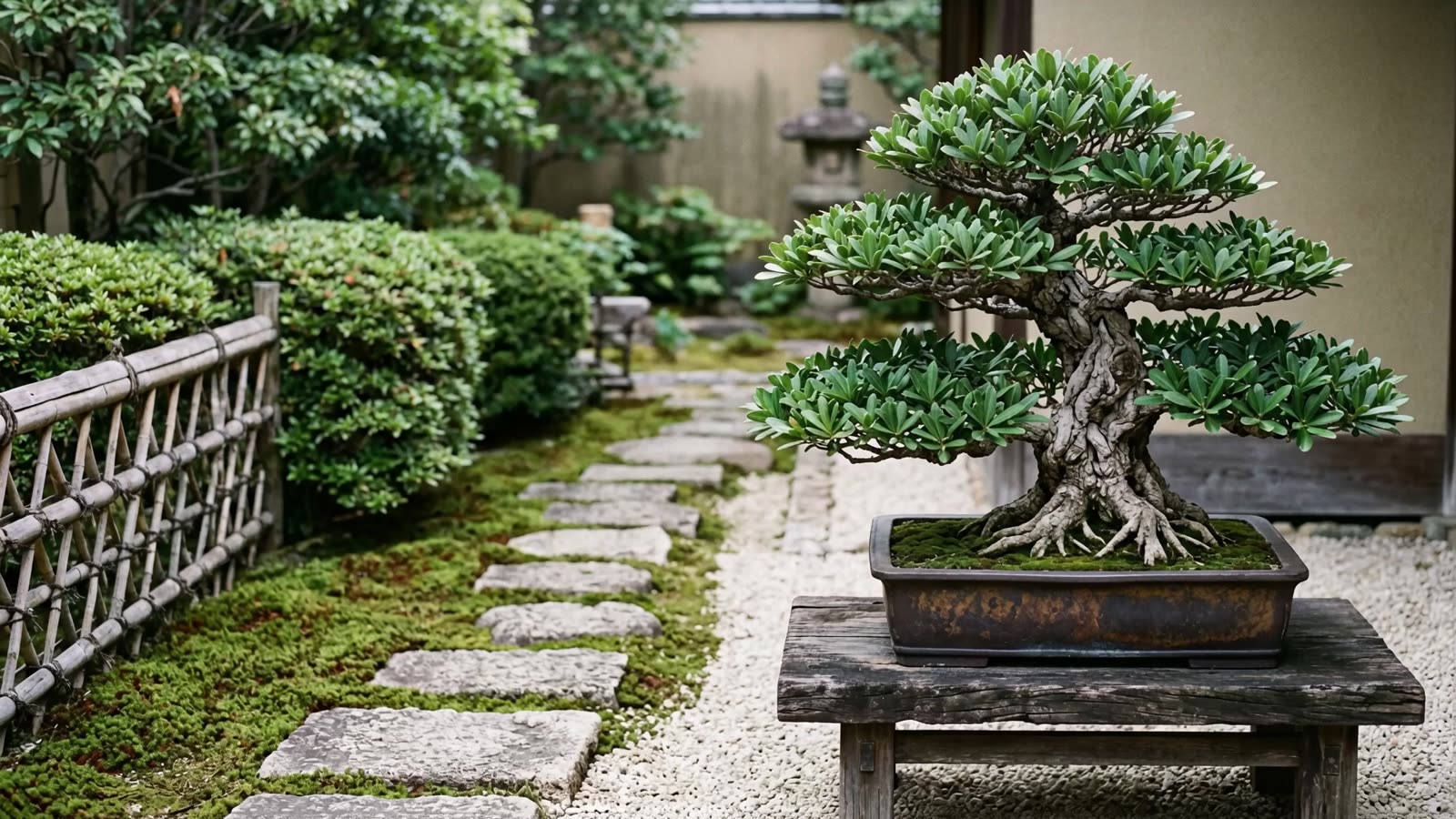
What it is
Podocarpus costalis belongs to the Podocarpaceae — broadleaf conifers that carry no true cones. In the wild it grows on limestone cliffs and coral soils at the sea edge, taking salt wind and thin substrate. That origin explains its tolerance of shallow pots.
How to recognise it
This is the section that matters if you are trying to confirm what you own.
- Short, broad leaves around 3–5cm, noticeably thick and leathery to the touch.
- Blunt, rounded leaf tips — never the drawn-out point of kusamaki.
- Leaves packed tightly in whorls at the branch ends, giving a dense, shrubby look.
- Deep, saturated, glossy green with no blue cast whatsoever.
- Stout trunk that thickens quickly, with pale grey-brown bark.
Why it works as bonsai
Costalis develops mature bark faster than the other two, so even young trees read as old. Back-budding on old wood is reliable, which means long branches can be cut back hard and rebuilt.
The broad leaf makes it most convincing at medium to large sizes. At shohin scale the leaf proportion is difficult to reduce enough to look right.
Care specific to this variety
- Wants a fast-draining mix; it is the most root-rot prone of the three.
- Tolerates wind and salt well, so an exposed bench suits it.
- Prune while growth is active so back-budding follows quickly.
Provenance and propagation
All our costalis comes from nursery cuttings and seedlings. It grows slowly from cutting, so thick-trunked material is always expensive — which is precisely why wild-collected stock still circulates.